Watches on Noon UAE: seller context — coupon troubleshooting · TAR53
If your Noon UAE coupon isn’t working when you’re shopping for watches, here’s a step‑by‑step troubleshoot guide that focuses on the seller context.
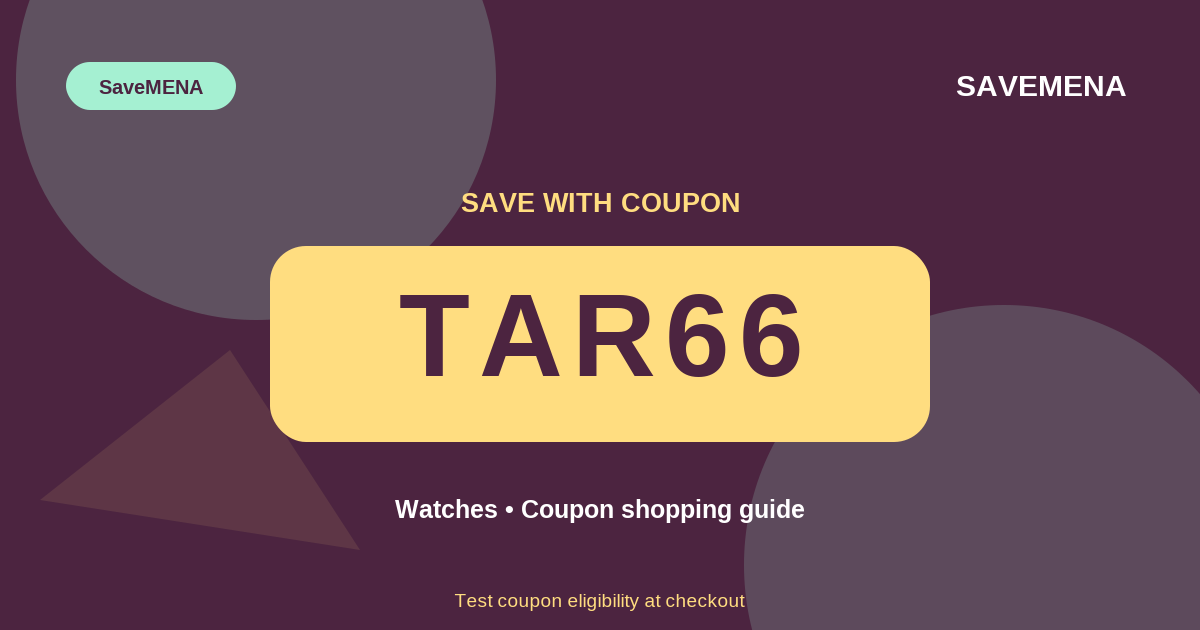
Codes available to try while comparing
These codes are not guaranteed for the article topic or listed brands; test them at checkout and use the live result.
1. Understanding Seller Context on Noon
Every watch listing on Noon is managed by a distinct seller who sets terms around pricing, shipping, return windows, and discount eligibility. Sellers may join Noon as independent merchants or as verified partners. These distinctions affect how promotional codes are treated; some sellers permit all coupons, while others restrict coupon usage to their own exclusive discount engines. Knowing this basic framework helps you identify why a coupon might be rejected at validation time. It also clarifies that a single coupon like TAR53 might shuffle through internal rules before it reaches the billing interface.
Because sellers control some aspects of the checkout, the first thing you should do is locate the seller’s storefront or profile link on the product page. From there evaluate whether they have a public “eligible for coupons” badge or any mention of third‑party codes in their description. Sellers sometimes hide coupon support in FAQ sections or behind a “contact a seller” link. By gathering this information early, you can skip later steps that would otherwise be redundant if the seller outright disallows external coupons.
2. Verifying Seller Eligibility for External Coupons
Once the seller is identified, check for any stated restrictions on external coupon usage. Many sellers will list a “coupon policy” that indicates whether discount codes from other platforms or generic coupons can be applied. If the seller’s policy is silent, proceed by adding the watch to your cart and verifying whether the coupon triggers immediately or flashes an error that refers to seller restrictions. This in‑cart test provides instant feedback on eligibility.
If the seller’s policy explicitly prohibits external coupons, the solution is twofold: either look for an alternative seller whose listings list coupon acceptance or request a seller‑issued discount via the shop’s “apply a discount” option. The latter can provide a code that’s pre‑approved and will work at checkout. Either approach ensures that you do not waste time expecting a coupon that the seller will always reject.
3. Checking the Coupon’s Compatibility with Watch Products
The TAR53 code may the coupon code specific categories, but without knowing the exact parameters, you should confirm that the watch product qualifies. Add the watch to your cart, open the “applied coupons” pane, and observe whether the system flags the product category or SKU as incompatible. Purchases that fall outside the specified category will not trigger the discount, regardless of seller compatibility.
Even if the seller allows the coupon, Noon may still reject it if the item is under a restricted collection, a limited edition, or a stock‑re‑ordering model. Since watch listings vary widely—from fashion, smart, to luxury mechanical pieces—such discrepancies often dictate coupon applicability. Therefore, double‑check the product description for any mention of “exclusive launches” or “limited availability” that might be conflated with the coupon’s scope.
4. Confirming Cart Conditions that Affect Coupon Application
Coupon mechanisms depend not just on single items but also on cart totals, quantities, and the presence of free add‑ons. For instance, if the watch has a mandatory warranty or a complimentary strap added automatically, those extra items might bump the cart to a non‑qualifying range. To assess this, manually verify the cart subtotal, including any add‑ons, then see if the coupon is still rejected. Removing optional extras temporarily can help isolate whether the cart as a whole meets the coupon condition.
Additionally, if the cart contains any other items from the same or different sellers, the coupon might be blocked due to cross‑seller limitations. Many sellers enable the coupon only for single‑seller purchases, so a multi‑seller shopping bag will often cause the system to ignore the code entirely even if that seller explicitly accepts it. Keeping a single‑seller cart while testing the coupon simplifies the validation process.
5. Reviewing Delivery and Payment Method Constraints
While delivery fees and payment options are usually peripheral to coupon logic, they can indirectly trigger validation rules that block discount application. For example, if the delivery method chosen is “express” or “store pickup” and the seller does not support coupons on those methods, the discount will be discarded during the order finalization step. Logging in to the order summary after applying the coupon will show whether any delivery‑related errors appear.
Similarly, certain payment methods may be flagged as “non‑discount eligible” by either the seller or Noon’s internal policies. If the cryptocurrency or MADA wallet button is a default, switching to a standard credit card may resolve an issue that seemed tied to the coupon itself. Again, these checks are precautionary and help you refine the post‑application validation.
6. Inspecting Product Variants and SKU‑Level Requirements
Watches often come in multiple sizes, colors, or material variants, each represented by a unique SKU. Tamarash might set a discount on only certain SKUs, not on the entire product category. Specifically assess whether the selected variant—say a gold‑bracelet model versus a steel‑bracelet model—has an exclusivity clause that disallows third‑party codes. The coupon code entry will not process if the variant is flagged as “Non‑coupon Eligible.”
To confirm, review the variant selection screen for any message or note that indicates “No coupon allowed.” If such a note appears, swish to another variant that lacks the warning. This step ensures that you are not mistakenly applying a valid code to an ineligible SKU even though the seller allows coupons for the product line.
7. Cross‑Checking Noon Web vs. App Coupon Behavior
Coupons sometimes behave differently on the Noon mobile app compared to the web platform. The app may enforce stricter checks or provide a more user‑friendly error banner, while the web interface might silently ignore the coupon until after the payment step. If a discount fails on one platform, toggle the platform to verify whether the same issue recurs.
Before testing, sign out and log back into both the web and app versions to clear any cached session data. A clean login state can reveal whether the coupon code was previously invalidated during the session. This dual‑platform verification is vital for sellers who manage inventory differently across the two interfaces.
8. Escalating to Noon Support with Seller‑Specific Evidence
When all internal checks—seller policy, product variant, cart totals, delivery options, and platform differences—rule out the coupon failure, your next step is to engage Noon customer support. Provide them with screenshots of the seller’s policy, the cart state, the error message, and the coupon code. A structured report shows you’ve exhausted common troubleshooting pathways, which can expedite a resolution.
In your support ticket, request explicit confirmation that the seller accepts external coupons and whether TAR53 can be validated for the chosen watch SKU. If Noon’s side finds an issue on their end, they may generate a replacement code or adjust the seller’s policy at a later time, offering a path to secure the discount once more. Until then, proceeding with a direct payment is best to complete the purchase safely.
Related SaveMENA pages
Related articles
Official sources to check
Frequently asked questions
Why does my Noon UAE coupon not apply to a watch even though the seller says coupons are allowed?
The coupon may be restricted to specific SKUs or variants, or there may be cart limit or delivery constraints that trigger a failure during final validation; these nuances are often not obvious until checkout, so double‑check variant and cart totals.
Can I still use TAR53 if my cart contains multiple sellers?
Coupons generally apply to single‑seller carts; if you have items from more than one seller, Noon may reject the code. Keeping the cart to one seller or removing the other items usually resolves the issue.
What should I do if I keep receiving an error after applying the coupon on both web and app?
Gather screenshots of the error, the seller’s coupon policy, and the cart details, then submit a support ticket to Noon with the code and request confirmation of eligibility.
Is there a maximum number of watches I can add to a cart with a single coupon?
Buyers should verify at checkout; the system will accept or reject the coupon based on total quantity and selected variants, which may be outside the coupon’s inclusion criteria.